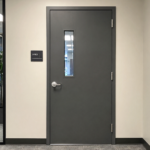
If you manage a retail store, office building, or warehouse, your commercial doors take an absolute beating. Hundreds of people push, pull, and shoulder them open every day. The only thing keeping that heavy aluminum and glass slab from slamming into the frame, or into a customer, is the door closer mounted at the top.
Our technicians get countless calls for commercial door repair from clients who think their frame is warped or their hinges are shot, when the real culprit is a failing closer. A healthy closer controls the door’s speed and makes sure it latches securely, sealing your building from the weather and keeping your security intact. Before you grab a ladder and a hex key, here is how these mechanisms work and when an adjustment crosses the line into a professional repair.
Anatomy of a Door Closer: Sweep, Latch, and Backcheck
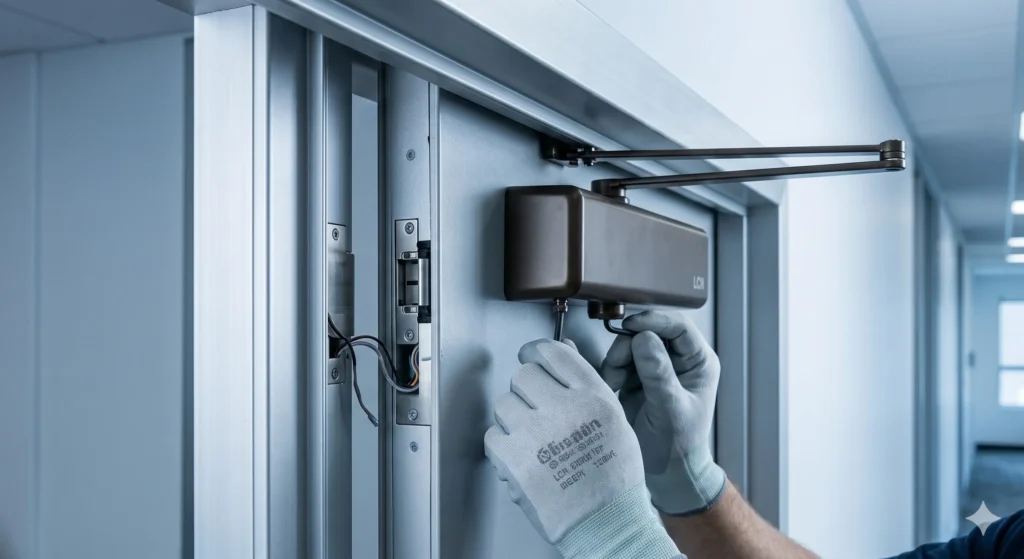
A door closer is not just a heavy-duty spring. It is a precisely engineered hydraulic mechanism. The spring pushes the door closed, but the hydraulic fluid inside the cylinder controls how fast that spring is allowed to decompress. You manage that fluid with small adjustment valves, and each one governs a different stage of the closing cycle.
- Sweep (main speed): Controls the door’s speed from fully open down to the last few inches. If your door takes twenty seconds to close and lets all your air conditioning out, the sweep valve is too restricted.
- Latch speed: Governs the critical final ten degrees. The door needs a slight burst of speed here to overcome wind pressure, weatherstripping, and the latch. If your door stops an inch short of the frame, the latch valve needs calibration.
- Backcheck: Prevents the door from flying open too fast and hitting a wall or overextending the hinges. When a gust of wind catches the door, backcheck engages like a brake.
Telltale Signs of a Failing Closer
How do you know whether your closer needs a tweak or is completely dead? These are the red flags we look for on a service call.
- Violent slamming: If the door slams hard enough to rattle the glass, the internal seals have probably failed and the hydraulic fluid is no longer restraining the spring.
- Failure to latch: A door that closes but does not latch is a major security liability. Sometimes it is a latch-speed issue. Other times the spring has simply lost its tension over the years.
- Heavy resistance: If it feels like pushing a boulder to get in, the backcheck may be engaging too early, or the closer body is sized incorrectly for the door’s weight.
- Oil on the cylinder: Dark fluid weeping down the closer body or dripping onto the frame means the seals are blown.
The Danger of the DIY Hex Key Fix
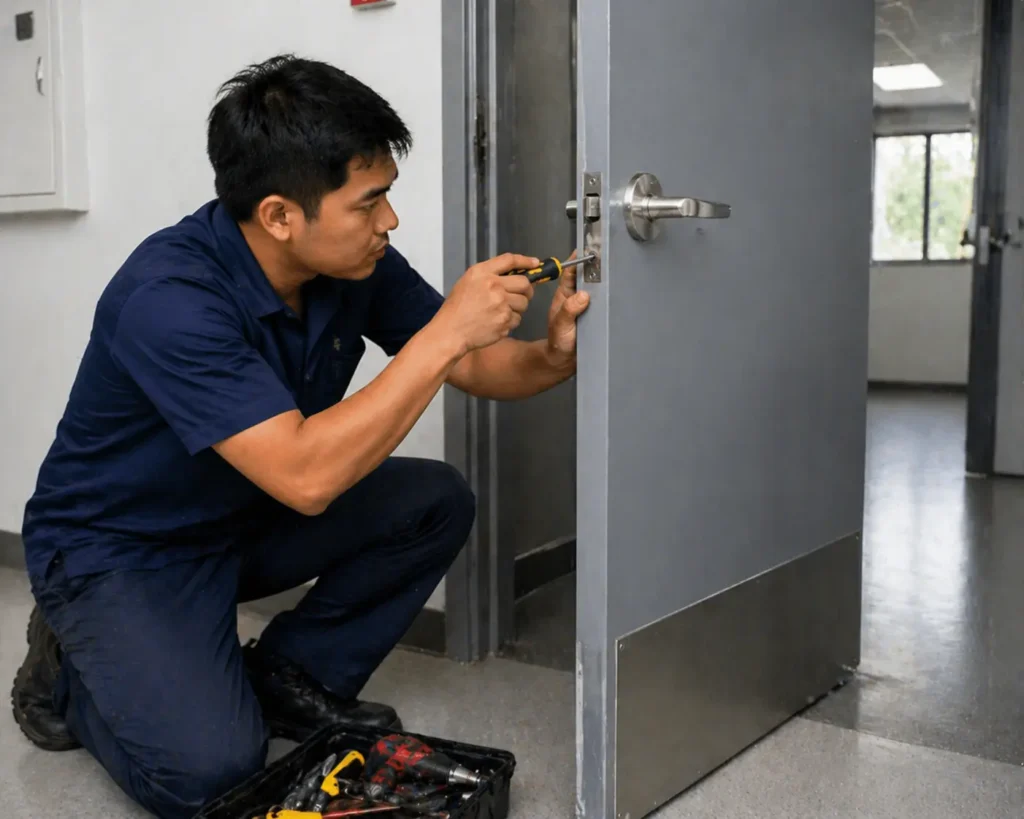
We see it all the time. A building manager watches a quick video, grabs an Allen key, and starts twisting the adjustment screws on the closer.
Here is the reality. Those hydraulic valves are extremely sensitive. Adjustments are made in turns of an eighth or a sixteenth at a time. If you back a valve screw out too far, usually more than two full turns, you unseat the O-ring. The moment that happens, pressurized hydraulic fluid shoots out over you, the door, and the floor.
Once a closer has dropped its oil, it is dead. There is no way to refill or rebuild it on site. What could have been a ten-minute adjustment has become an emergency door closer replacement. If you see oil weeping down the cylinder, skip the hex key. The seals are blown, and it is time to call a professional.
Beyond the Closer: Hinges, Pivots, and Air Pressure
Sometimes the closer is not the root cause at all. Commercial buildings often suffer from stack pressure, a vacuum effect created by the HVAC system. If the air pressure inside the building is fighting the door, even a perfectly calibrated closer will struggle to latch.
Worn bottom pivots, sagging continuous hinges, or an unaligned frame will also make the door drag on the threshold. A closer is designed to close a free-swinging door. It is not strong enough to force a dragging, misaligned slab of glass across concrete. If you suspect alignment issues, you need comprehensive commercial door repair and alignment before the dragging destroys your hardware. Businesses on a regular maintenance schedule catch these problems long before they become emergencies.
When to Adjust and When to Call
- Reasonable to adjust: A door that has slowed slightly with the seasons and needs a small sweep or latch tweak, on a closer with no leaks and no slamming.
- Call a professional: Slamming, failure to latch after a small adjustment, heavy resistance, visible oil, a door that drags, or any closer on an accessible or fire-rated entrance where the closing force is regulated.
Frequently Asked Questions
Why does my commercial door slam shut?
Slamming almost always means the hydraulic control has failed, either because the seals have blown or the closer has lost its fluid. The closer usually needs replacement rather than adjustment.
Why won’t my door closer pull the door fully closed?
Either the latch-speed valve is set too slow, the spring has weakened, or something else is fighting the door: stack pressure, worn weatherstripping, or a dragging pivot. A technician checks all three.
How much should I turn a door closer adjustment screw?
An eighth of a turn at a time, then test. Never back a valve out more than two turns, or you risk unseating the seal and losing the fluid.
Can a leaking door closer be repaired?
No. Once a closer leaks hydraulic fluid it cannot be resealed or refilled on site. Replacement is the only fix.
How long does a commercial door closer last?
A properly sized, quality closer often lasts ten years or more. Undersized closers, high traffic, and repeated slamming shorten that considerably.
Let’s Get Your Doors Operating Smoothly
Your commercial entrances are vital to your business’s security, energy efficiency, and customer experience. A slamming door is a liability, and a door that will not latch is a security threat. While minor seasonal adjustments are normal, leaking fluid, blown seals, or heavy dragging call for professional expertise.
Do not let a faulty door closer disrupt your business or compromise your safety. Mr. Door Repair technicians carry the hardware to diagnose, adjust, or replace heavy-duty closers and pivots on the spot for businesses across Toronto and the GTA. Is your storefront door giving you trouble? Contact Mr. Door Repair today to book a service call and get your entrance operating smoothly, safely, and securely.