If you manage a warehouse, distribution centre, or retail loading area anywhere in the GTA, the overhead door at your dock isn’t just a big piece of steel that goes up and down. It’s the boundary between a secure, climate-controlled operation and everything outside it: weather, break-in risk, energy loss, and the flow of trucks and staff through your facility every single day. Choose the wrong door and you’ll feel it in higher heating bills, more downtime for repairs, and insurance or code headaches down the line. Choose the right one and it quietly does its job for years without anyone thinking twice about it.
The trouble is that “commercial overhead door” covers a wide range of products built for very different jobs, and the specs that matter for a busy loading dock in January are not the same ones that matter for a quiet storage building or a showroom bay. This guide walks through the door types, the practical factors that should drive your decision, the security and access questions worth asking, and how to tell when it’s time to repair versus replace. Along the way we’ll point out where a Toronto-area door and hardware contractor like Mr. Door Repair fits into the picture, even on the parts of your building envelope that aren’t overhead doors themselves.
Types of Commercial Overhead Doors
Commercial overhead doors aren’t a single product category. Manufacturers build them around very different mechanisms and materials, and each type has a sweet spot depending on how often the door cycles, what’s moving through the opening, and how much climate control the space needs.
Sectional Steel Doors
Sectional steel doors are the most common choice for loading docks and warehouse bays across Ontario. They’re built from horizontal panel sections that travel up a vertical track and curve back along the ceiling, which lets the door open fully without swinging into the yard or eating up headroom inside. Steel sectional doors are generally durable and repairable in panel-sized sections rather than as one unit, which can simplify maintenance after an impact from a forklift or truck.
Rolling Steel or Coiling Doors
Rolling steel doors coil up into a compact drum above the opening instead of traveling back along the ceiling. That makes them a good fit where ceiling space is tight or where the opening needs to sit close to an exterior wall with nothing behind it. They’re common on smaller service openings, security shutters, and older commercial buildings that were never designed with a sectional door’s overhead track in mind.
High-Speed Fabric and Rapid Roll Doors
High-speed doors, sometimes made from reinforced fabric rather than steel, are designed to open and close far faster than a standard sectional door. They’re used heavily in food processing, cold storage, and high-traffic interior openings where holding a temperature-controlled space and keeping traffic moving both matter. Because they cycle so much more often than a typical dock door, cycle life and motor durability become much bigger factors in the buying decision.
Insulated vs. Non-Insulated Doors
Any of the door types above can come in insulated or non-insulated versions. An insulated door uses a polystyrene or polyurethane core sandwiched between steel skins, and the difference in comfort and energy performance inside a heated Canadian warehouse in February is significant. Non-insulated doors are lighter and less expensive, and they can be perfectly acceptable for unheated storage buildings or mild-climate applications, but for anything conditioned or occupied, insulation usually pays for itself.
Key Factors to Consider Before Choosing a Door
Once you understand the basic door types, the real decision comes down to matching a product to how your building actually operates. A handful of factors consistently separate a good long-term choice from a door that becomes a maintenance headache within a couple of years.
Usage frequency and cycle count matter more than almost anything else. A door that opens twenty times a day at a busy distribution hub needs a heavier-duty operator, springs rated for a much higher cycle life, and hardware built for constant use, while a door that opens twice a day at a small storage facility can get by with lighter-duty components. Insulation and R-value should be weighed against your heating costs and whatever space is on the other side of that door; a conditioned warehouse loses real money through an underinsulated bay door over a Canadian winter. Wind load and structural ratings are a code requirement in many municipalities and matter even more directly on taller buildings or exposed sites where wind pressure on a large door surface is significant. Security rating, meaning the gauge of steel, the quality of the locking hardware, and resistance to prying or impact, deserves real attention on any door that faces a laneway, alley, or lower-traffic side of the property. Cycle life, the number of open-close cycles a door and its springs are rated to survive, should be matched honestly to how the opening will actually be used rather than to the lowest sticker price.
- Traffic volume: match the door and operator duty cycle to how often the opening actually gets used each day.
- Climate performance: weigh insulation value against heating and cooling costs for the space behind the door.
- Wind and structural load: confirm the door meets local building code requirements for your site’s exposure.
- Security rating: look at steel gauge, locking hardware, and impact resistance for exposed openings.
- Cycle life: choose springs and hardware rated for realistic long-term use, not just initial cost.
Security and Access Considerations
An overhead door is only as secure as the locking hardware and access system built around it, and this is where the buying decision extends well beyond the door panel itself. A high-security steel door with a weak or outdated lock is still a weak point, and many GTA businesses are moving toward automated and access-controlled entries rather than manual chain hoists and padlocks. Automatic operators reduce the time a door sits open during loading, which cuts both energy loss and the window of opportunity for unauthorized entry, and pairing that automation with a proper access control system lets you track exactly who is opening which door and when.
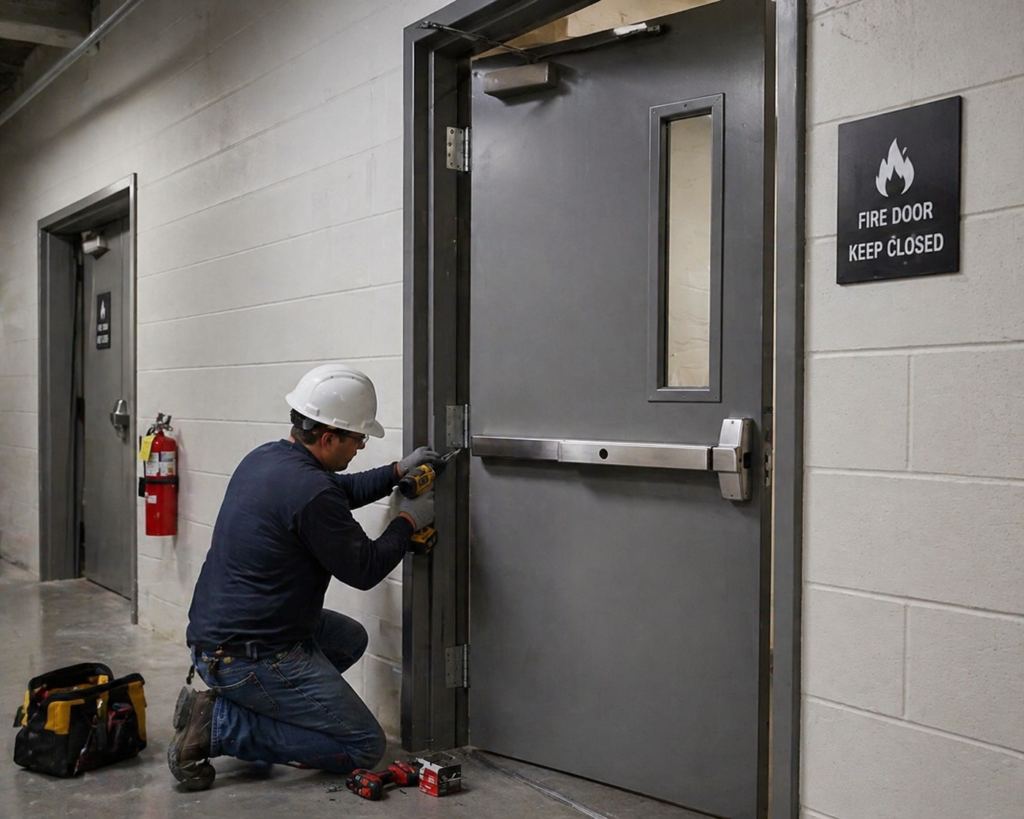
This is also where it’s worth thinking about the rest of your building envelope at the same time you’re planning an overhead door purchase. Loading bays rarely exist in isolation; the same facility usually has personnel doors, storefront entries, or emergency exits that need to meet their own code and security standards. Reviewing panic bar and electric strike hardware on adjacent exits, and confirming your fire-rated steel doors and frames are still compliant, is a natural companion project to any overhead door upgrade, since inspectors and insurers tend to look at the whole building, not just one opening.
Maintenance and Lifespan Expectations
Commercial overhead doors are mechanical systems with a lot of moving parts, springs under significant tension, rollers, tracks, cables, and an operator, and every one of those parts wears differently depending on how hard the door works. Regular inspection is what separates a door that reaches the end of its useful service life gracefully from one that fails suddenly, often at the worst possible moment during a delivery window.
A sensible maintenance routine includes periodic lubrication of rollers and hinges, visual checks of cables and springs for fraying or corrosion, and confirming that safety sensors and reversing mechanisms are still functioning correctly. Track alignment should be checked periodically too, since a door that binds slightly in its track puts extra strain on the operator and springs every time it cycles. Facilities that treat this as a scheduled task rather than a reactive one tend to get more useful years out of their doors and catch small problems, a fraying cable or a misaligned roller, before they turn into a jammed door blocking a loading bay. The Canadian Standards Association publishes guidance relevant to building products and safety systems that facility managers can reference when setting internal maintenance standards, and the Canadian Centre for Occupational Health and Safety is a useful resource for the workplace safety side of powered door operation, since a malfunctioning overhead door is also a safety hazard for staff working near it.
Signs an Existing Overhead Door Needs Replacing vs. Repair
Not every problem means the whole door needs to go. Plenty of overhead door issues, a worn roller, a stretched cable, a misadjusted limit switch, are straightforward repairs that restore normal operation without touching the door panels themselves. But there are signs that point toward replacement rather than another round of repairs.
A door that has taken repeated impact damage across multiple panels, or one where the track and structural frame have been bent out of alignment more than once, often costs more to keep patching than to replace outright. Visible rust or corrosion working through the steel, especially around the bottom panels where road salt and moisture collect during a Toronto winter, is a sign the door’s structural integrity is declining rather than just its appearance. Rising energy bills tied to a specific bay, drafts you can feel standing next to a closed door, or condensation and frost forming on the inside of the panels usually point to failing insulation or seals that a repair won’t fully fix. And if a door is cycling far more slowly than it used to, or the operator is straining and overheating, the springs and hardware may simply be past their rated service life for the volume of traffic the door sees.
Working with the Right Contractor
Whoever you hire to install, service, or advise on a commercial overhead door should be licensed, properly insured, and comfortable walking you through the applicable building and fire code requirements for your specific occupancy. Ask for proof of insurance before any work begins, and ask what warranty applies to both parts and labour. A contractor who is willing to do a proper site inspection, measuring the opening, checking headroom and side room, reviewing existing wiring for an operator, before quoting a number is generally a better sign than one who prices a door over the phone.
It’s also worth choosing a contractor whose scope covers more than just the door itself, since a loading dock or commercial entry is rarely an isolated system. Mr. Door Repair is a licensed and insured door and hardware contractor serving Toronto and the GTA, and while overhead and sectional bay doors themselves fall outside our current scope of work, we regularly help commercial clients with the surrounding systems that make a facility secure and code-compliant: fire-rated steel doors and frames, automatic door operators, access control, storefront glass and aluminum systems, and panic bar and closer hardware on the doors your staff and customers use every day.
Frequently Asked Questions
What is the difference between a commercial overhead door and a residential garage door?
Commercial overhead doors are built with heavier-gauge steel, higher cycle-rated springs, and stronger operators to handle much more frequent daily use than a residential garage door. They’re also designed to meet commercial building codes for wind load, fire separation, and in some cases insulation performance that residential doors aren’t rated for.
How much does a commercial overhead door typically cost?
Pricing varies widely based on door type, size, insulation, and operator specifications, so it’s best to get a site-specific quote rather than rely on a general price range. A licensed contractor who measures your opening and reviews your usage needs can give an accurate estimate.
How long does a commercial overhead door last?
Lifespan depends heavily on cycle count, maintenance, and exposure to weather and impact damage. A well-maintained door with regular inspections and prompt repairs will generally outlast one that’s neglected or subjected to constant heavy use without upkeep.
Do commercial overhead doors need to be insulated?
Insulation isn’t mandatory for every application, but it’s strongly recommended for any heated, cooled, or occupied space behind the door. Natural Resources Canada notes that building envelope components, including large doors, are a meaningful factor in a commercial building’s overall energy performance.
What size opening does a standard loading dock door need?
Standard dock door sizes vary by industry and vehicle type, but the opening should be sized to the largest trailer or vehicle regularly using that bay, with clearance for mirrors and dock levelers. A contractor should measure your specific dock rather than assume a standard size fits your operation.
How often should a commercial overhead door be inspected?
Most facilities benefit from a scheduled inspection at least once or twice a year, with more frequent checks for high-cycle doors used many times per day. Regular inspection catches worn cables, springs, and misaligned tracks before they cause a failure during business hours.
Can an existing overhead door be upgraded with an automatic operator or access control?
In many cases yes, provided the door and track are structurally sound enough to support the added hardware. It’s worth having a qualified contractor assess the existing door before adding automation, since retrofitting a worn-out door often isn’t cost-effective.
Get the Rest of Your Commercial Doors Right, Too
Choosing the right overhead door is a real investment decision, and it deserves the research this guide walks through: matching door type to traffic volume, weighing insulation against your heating bills, checking wind load ratings, and thinking through security from the panel down to the locking hardware. Once that decision is made, or if you’re simply auditing the rest of your building’s doors and hardware at the same time, that’s exactly where Mr. Door Repair can help. We handle steel entry and fire-rated door and frame repair, automatic door operator service and installation, access control systems, storefront glass and aluminum systems, and panic bar, closer, and electric strike hardware for commercial properties across Toronto and the GTA. If your business is planning a broader door and security upgrade alongside a new overhead door, or you need ongoing maintenance and service calls for the doors we do service, contact our team to talk through what your building needs. You can also browse our full range of commercial services or check the Mr. Door Repair blog for more guides like this one.